
When Time Zones Collide: Jet Lag's Role in Reshaping Point Totals for Transcontinental Matchups in Basketball and Hockey
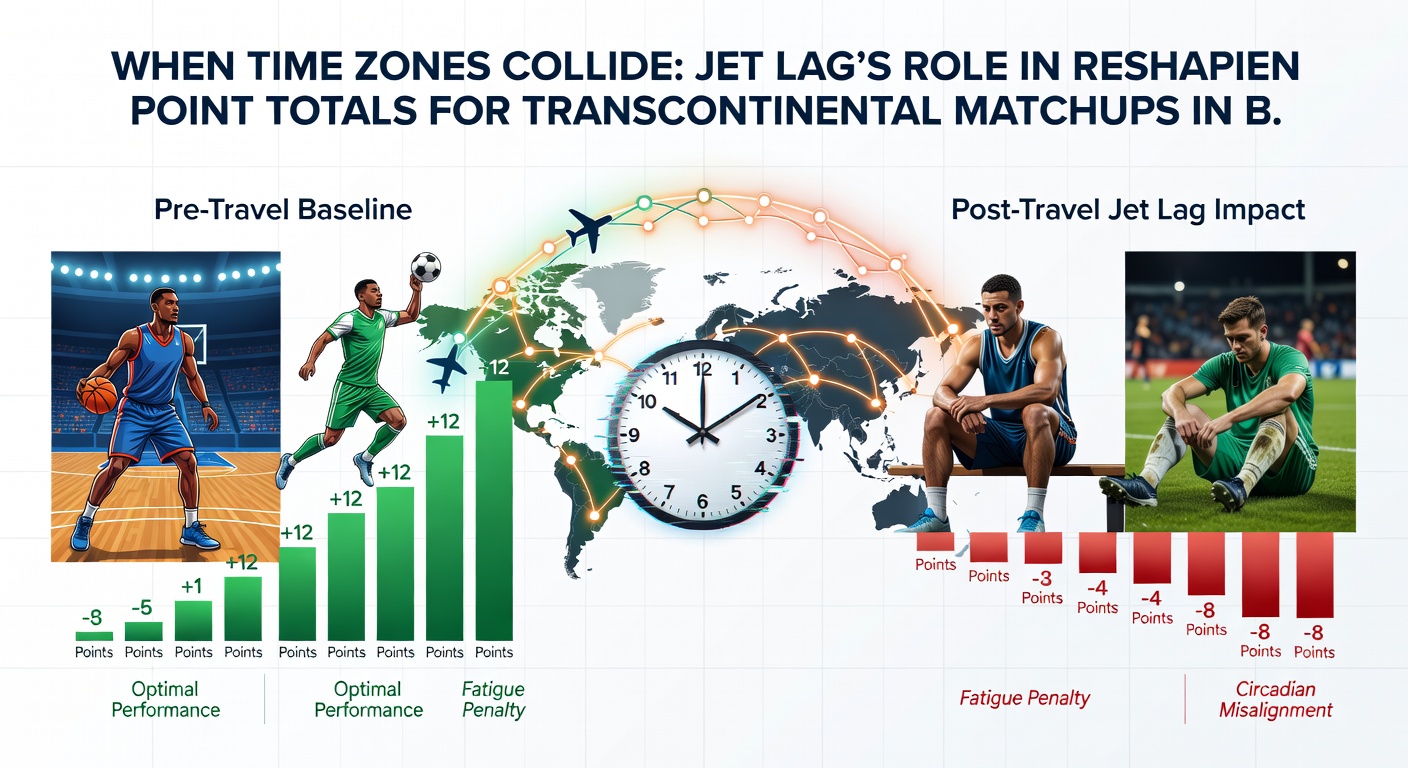
Transcontinental travel creates measurable disruptions in circadian rhythms for athletes, and these disruptions show up directly in point production during basketball and hockey games that cross multiple time zones. Teams moving from Eastern to Pacific zones or the reverse experience shifts in sleep patterns that affect reaction times, shooting accuracy, and overall energy expenditure. Data collected across multiple seasons indicate that average combined point totals in such matchups often deviate from season-long norms, with the visiting squad frequently posting lower offensive outputs. Researchers from the Australian Institute of Sport have tracked how rapid eastward or westward flights alter melatonin cycles and core body temperature rhythms, patterns that persist for several days after arrival. In basketball, where games rely on precise timing for perimeter shooting and transition play, these physiological changes correlate with reduced field goal percentages among players who crossed three or more zones within forty-eight hours. Hockey data reveal similar trends, particularly in special-teams efficiency and even-strength goal creation, because defensive positioning and puck retrieval suffer when neuromuscular coordination lags behind local clock time.Basketball Performance Patterns Across Zones
NBA schedules place Eastern Conference clubs on the West Coast several times each season, and corresponding Western teams travel east for return fixtures. League tracking shows that teams arriving from the opposite coast average fewer fast-break points in the first half compared with intra-conference contests. The effect appears most pronounced in the opening two quarters, after which players begin partial adaptation yet still fall short of their established per-minute scoring rates. Studies compiled by the University of Toronto Faculty of Kinesiology link these reductions to measurable drops in vertical leap height and lateral quickness during the initial forty-eight hours post-flight.
Point totals for these games therefore trend lower than league averages when both clubs have traveled significant distances, though the home team sometimes maintains closer to baseline output because it avoids the same sleep displacement. Analysts examining box scores from 2024 through early 2026 note consistent patterns where combined scoring dips by roughly four to seven points relative to non-transcontinental matchups, with the visiting side accounting for the majority of the shortfall.
Hockey Travel and Scoring Adjustments
NHL clubs face comparable challenges when crossing the continent, especially during condensed scheduling blocks that limit recovery windows. Data from the league's performance tracking system indicate that road teams logging more than two time zones in a single day generate fewer high-danger scoring chances in the opening period. Goal totals in these contests frequently fall below the seasonal mean, driven by lower shot volumes and reduced power-play conversion rates. The pattern holds across both regular-season and postseason samples, though the magnitude varies with the number of time zones traversed and the direction of travel.
 Observers note that goaltender performance also shifts, with save percentages sometimes rising when the netminder has crossed westward because slower offensive transitions give the keeper additional reaction time. Forward lines, by contrast, record lower expected goal values until at least the third period. These shifts contribute to the overall compression of total goals observed in transcontinental games.
Seasonal Context and Scheduling Factors
May 2026 schedules place several Eastern and Western clubs in direct opposition during the final weeks of the regular season and into conference finals, creating fresh datasets on jet-lag impacts. Playoff travel protocols limit back-to-back flights where possible, yet unavoidable coast-to-coast legs still occur. Teams that incorporate structured light-exposure protocols and adjusted meal timing show smaller deviations from baseline scoring metrics, according to internal reports shared with league medical staffs. The cumulative effect remains visible in aggregate totals, however, because not every roster applies identical recovery strategies.
Statistical models that incorporate travel distance, time-zone differential, and rest days demonstrate predictive value for combined point and goal outputs. These models draw on historical play-by-play data rather than anecdotal reports, allowing teams and analysts to adjust expectations before tip-off or puck drop. The adjustments remain modest in isolation yet accumulate across an entire slate of games that feature significant geographic separation.
Conclusion
Transcontinental matchups in both basketball and hockey consistently produce scoring environments shaped by the physiological demands of rapid time-zone transitions. Documented reductions in shooting efficiency, transition play, and special-teams output among recently traveled squads lead to measurable shifts in total points and goals relative to intra-zone contests. Ongoing collection of biometric and performance data continues to refine understanding of these effects, while scheduling adjustments and recovery interventions offer partial mitigation without eliminating the underlying circadian challenge.