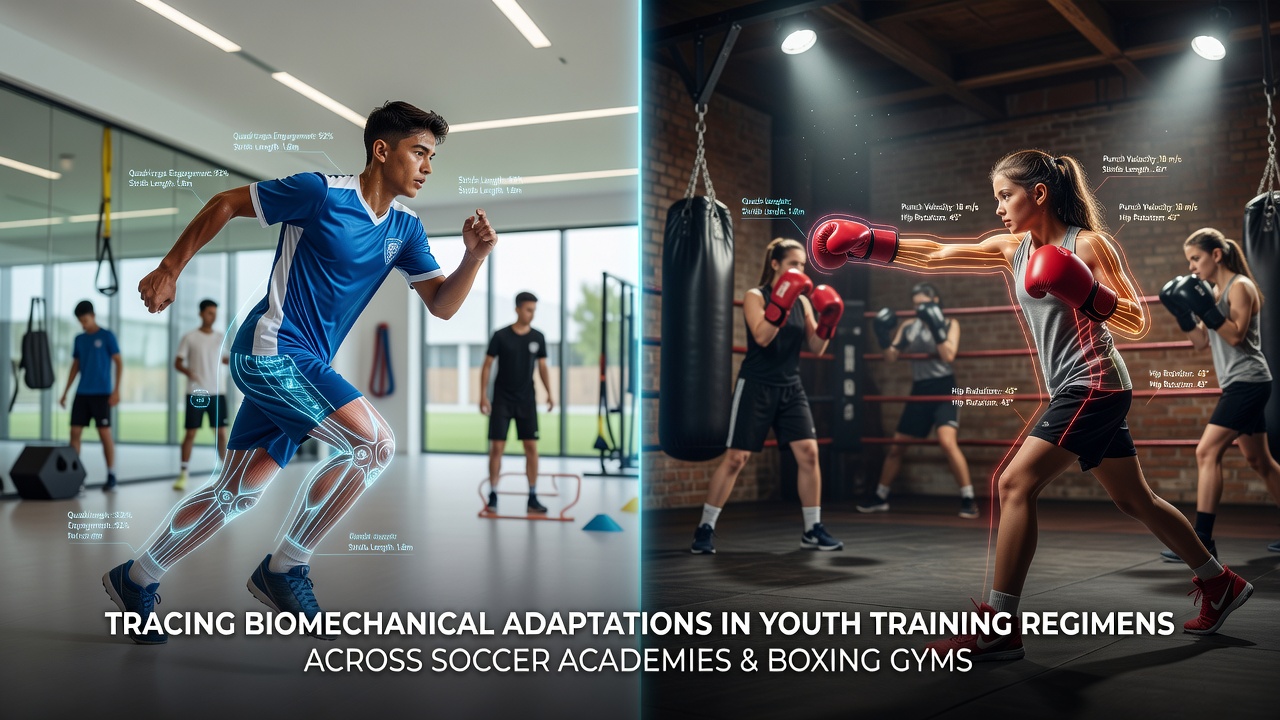
Tracing Biomechanical Adaptations in Youth Training Regimens Across Soccer Academies and Boxing Gyms
Youth training programs in soccer academies and boxing gyms produce measurable biomechanical adaptations that researchers track through motion capture systems, force plates, and electromyography, with data collected across multiple cohorts since 2023 showing distinct patterns in joint loading and muscle activation sequences. Academies emphasize repetitive kicking and directional changes that alter hip flexion angles and ankle dorsiflexion ranges, while boxing regimens focus on rotational torque and linear propulsion that reshape shoulder girdle mobility and core stiffness over time.
Soccer Academy Protocols and Lower Extremity Shifts
Coaches in European and South American academies structure sessions around small-sided games and technical drills that load the quadriceps and gluteal groups asymmetrically, leading to increased peak knee extension moments during cutting maneuvers according to longitudinal studies published through 2025. Players aged 12 to 16 often exhibit reduced ground reaction force variability after 18 months of consistent exposure, which correlates with tighter stride lengths on the dominant side and compensatory external rotation at the non-dominant hip. These changes appear in academy records from Brazil's CBF development centers and Germany's DFB youth pathways, where motion analysis reveals earlier peak activation of the vastus medialis during deceleration phases compared with age-matched controls outside structured programs.
Boxing Gym Approaches and Rotational Adaptations
Boxing facilities in North America and Australia incorporate shadow boxing, heavy bag intervals, and footwork ladders that develop transverse plane power through the thoracic spine and pelvis, resulting in greater peak angular velocities during punch sequences after 12 to 24 months of training. Data from Canadian and Australian youth cohorts indicate elevated internal oblique recruitment on the lead side alongside increased glenohumeral external rotation range, adaptations that support higher punch frequency without proportional rises in lumbar shear forces. Trainers adjust stance widths and hand positioning based on individual anthropometrics, producing measurable shifts in center-of-mass projection that differ from the more linear accelerations emphasized in soccer.
Cross-Sport Comparisons in July 2026 Research
Comparative analyses released in July 2026 by teams affiliated with the American College of Sports Medicine highlight overlapping adaptations in ankle inversion control and hip abductor endurance between the two disciplines, while upper-body torque development remains largely boxing-specific. Soccer participants demonstrate superior single-leg stability scores on force platforms, yet boxing athletes show faster trunk rotation velocities that transfer partially to soccer throw-ins when cross-training occurs. Researchers note that both groups experience elevated patellar tendon stiffness, though the rate of change accelerates under soccer's multi-directional demands versus boxing's more sagittal emphasis during combinations.
Monitoring Tools and Injury Correlation Data
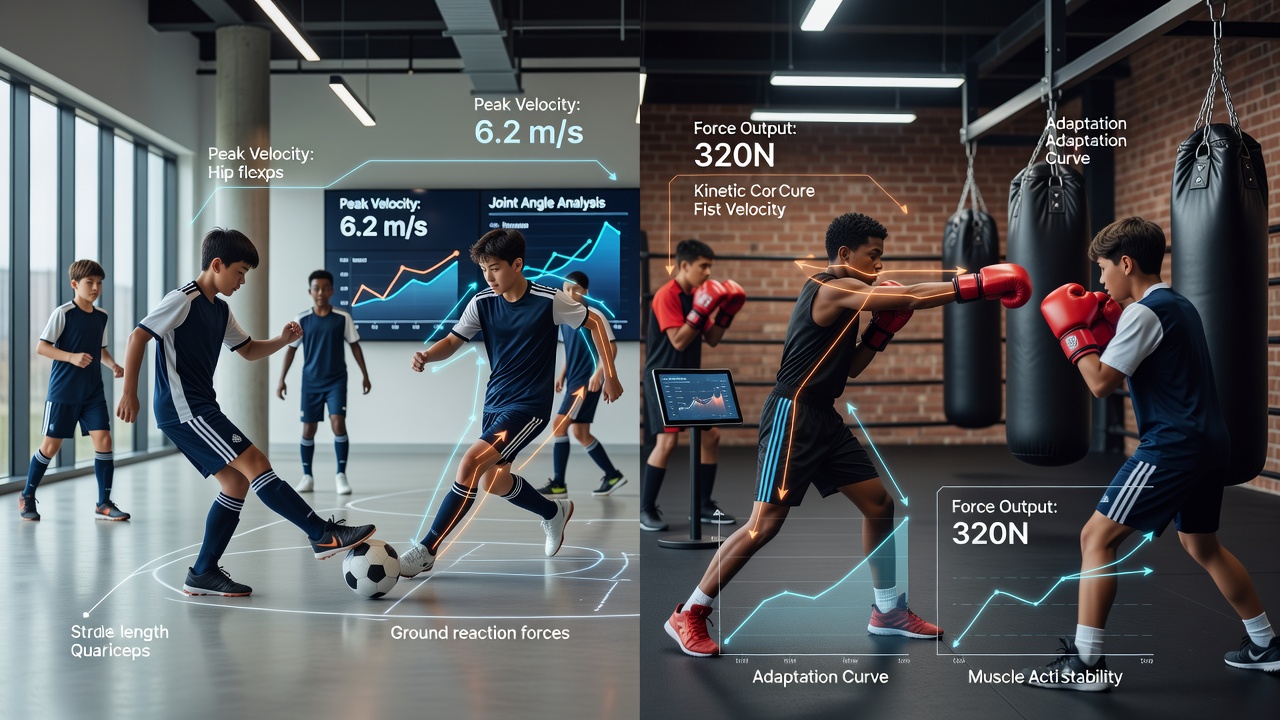
Facilities now integrate wearable inertial sensors and video-based markerless tracking to quantify adaptations in real time, allowing adjustments before excessive valgus collapse or scapular dyskinesis develops. Figures from the European College of Sport Science 2025 database link early identification of asymmetric hip internal rotation deficits in soccer players to lower incidence of groin strains, while similar monitoring in boxing gyms correlates reduced elbow hyperextension angles with fewer shoulder impingement reports. Training volume thresholds vary by age bracket, with 14-year-olds in both settings showing the steepest adaptation curves before plateauing around 17 years when skeletal maturity advances.
Regional Variations in Program Design
Programs in temperate climates schedule higher outdoor volumes that influence proprioceptive adaptations differently than indoor-dominant boxing gyms, producing subtle differences in plantar pressure distribution patterns during agility tests. Academies in Latin America prioritize ball mastery that accentuates forefoot loading, whereas North American boxing clubs emphasize plyometric push-up variations that enhance scapulothoracic rhythm. These geographic and sport-specific choices create distinct biomechanical signatures that researchers continue to map through standardized testing batteries administered at six-month intervals.
Conclusion
Biomechanical tracking across soccer academies and boxing gyms reveals sport-driven adaptations in joint ranges, muscle timing, and force distribution that evolve predictably with structured exposure, with 2026 datasets confirming both shared lower-limb responses and discipline-specific upper-body developments that inform individualized progression models.